Updated 15 Nov 2026 · Penang, Malaysia
Penang Property Buyer Guide 2026

Buying a new launch in Penang usually needs about 10% down payment plus roughly 3–5% of the price for stamp duty and legal fees, unless you qualify for the first-home exemption. This guide shows the real costs with calculators, explains your loan options, and walks through every step from booking to getting your keys.
By Vinn, Real Estate Negotiator REN81915 · General information, not legal or financial advice
How much does it cost to buy a property in Penang?
Plan for the down payment (usually 10%) plus stamp duty and legal fees, which together are roughly 3–5% of the price for a Malaysian buyer. Use the calculator for your own numbers.
Estimate only. Excludes disbursements, valuation and insurance. Many new launches offer free SPA legal fees and/or free loan legal fees, so check your package. Rates as at 15 Nov 2026.
MOT calculator: how much is stamp duty in Malaysia?
Malaysian citizens pay tiered stamp duty on the transfer (the Memorandum of Transfer, MOT) and 0.5% on the loan agreement. Non-citizens pay a flat 8% on transfers from 1 January 2026.
| Price portion | MOT rate (citizens & PR) |
|---|---|
| First RM100,000 | 1% |
| RM100,001 – RM500,000 | 2% |
| RM500,001 – RM1,000,000 | 3% |
| Above RM1,000,000 | 4% |
Each portion is charged at its own rate. Example: on RM600,000 the MOT is RM1,000 + RM8,000 + RM3,000 = RM12,000. Duty is based on the price or the market value, whichever is higher. The first-home exemption only applies to residential property; commercial units such as shops, offices and commercial-title serviced suites pay normal stamp duty.
Law: Stamp Act 1949 (First Schedule), as amended by the yearly Finance Acts. Official source: LHDN (Inland Revenue Board). Rates as at 15 Nov 2026.
How much are legal fees for buying a property?
Lawyers' fees for the sale and purchase agreement (SPA) and for the loan agreement each follow the same scale: 1.25% on the first RM500,000 and 1% on the next RM7 million, plus 8% SST and disbursements.
| Price or loan portion | Scale fee |
|---|---|
| First RM500,000 | 1.25% (minimum RM500) |
| Next RM7,000,000 | 1% |
| Above RM7,500,000 | Negotiable, max 1% |
For new launches, developers often pay the SPA legal fee (and sometimes the loan legal fee) as part of the package, which can save you over RM7,000 on a RM600,000 unit.
Law: Solicitors' Remuneration Order 2023 (in force 15 July 2023), under the Legal Profession Act 1976. Source: Malaysian Bar.
How much loan can I get? (Loan & DSR calculator)
Banks usually lend up to 90% of the price for your first and second home, and up to 70% from your third outstanding housing loan. Foreign buyers usually get between 60% and 85%, depending on the bank. Whether you qualify depends mostly on your debt service ratio (DSR): your total monthly loan repayments divided by your net monthly income.
Most banks look for a DSR of roughly 60–70%, depending on the bank and your income. Maximum tenure is usually up to 35 years or age 70, whichever comes first. Ask us for a free loan check before you book.
Source: Bank Negara Malaysia (70% loan-to-value cap from the third housing loan, since 2010).
Refinancing to buy your next property: new rules from 1 Jan 2027
Many investors cash out one home to fund the down payment on the next. From 1 January 2027, Bank Negara treats a cash-out for personal use as personal financing, so it counts much harder against your loan eligibility.
- The cash-out amount above your outstanding loan is assessed as if it is repaid over 10 years, not your 30-year home loan.
- Example: RM200,000 at 4% is about RM955 a month over 30 years, but about RM2,025 a month over 10 years, which raises your DSR.
- Exempt if used for renovation, MRTA, legal fees, education or business, with proof such as quotations or receipts.
- Flat-rate personal loans are banned for new loans, and banks must show the real (effective) interest rate.
Planning to cash out for your next purchase? Talk to your bank before 2027, and keep receipts for any renovation or legal fees.
Source: Bank Negara Malaysia, Personal Financing policy document (30 Sep 2025), Business Today.
Rental yield & ROI: what return can I get?
Rental yield is the yearly rent divided by the price. Return on your cash is what you keep each year after the loan and costs, compared with the cash you put in.
Monthly costs means maintenance, sinking fund, quit rent and assessment. We assume a 4% loan over 35 years, 1 empty month a year, and about 3% of the price for stamp duty and legal fees. Estimate only; ask us for real rents for the project you like.
Short-stay income = nightly rate × nights booked, after management and cleaning. Add utilities and internet to monthly costs. We assume a 4% loan over 35 years and about 3% of the price for stamp duty and legal fees. Short stays need a TIP licence, and most condos on Penang Island are not allowed; see the short-stay rules below.
As a rough guide, many Penang condos rent for a yield of about 3–5%. Dual-key and short-stay units can earn more. Growth in the property's value is not included.
Short stays in Penang: the TIP licence
Since 1 August 2026, any paid stay without a tenancy agreement, for up to six months, needs a TIP licence (Tempat Inap Persendirian) from the city council. On Penang Island, ordinary condos and apartments are not allowed, so most residential projects cannot be used for short stays.
| Penang Island (MBPP) | Mainland (MBSP) | |
|---|---|---|
| Condos and apartments | Not allowed (residential strata) | May be allowed |
| Serviced apartments, SoHo, SoFo, SoVo, suite and duplex offices | May be considered | May be allowed |
| Landed houses on individual title | May be considered, with a change-of-use application | Residential and commercial areas may be allowed |
- Apply to MBPP (island) or MBSP (mainland) by 1 November 2026.
- The building’s JMB or MC must approve it as a special resolution with at least 75% of the votes.
- Fees: RM50 to apply, RM1,000 a year for up to three rooms (RM200 per extra room) and RM1,800 a year per unit, about RM2,850 a year in all.
- Never allowed in low-cost, affordable or people’s housing; some neighbourhoods are excluded, and the George Town heritage zone has its own rules.
If you want holiday-rental income on the island, look at commercial-title serviced apartments whose building already allows short stays, and get it in writing. A regular condo is still a good long-term rental. Councils can inspect, fine and close premises that operate without a licence.
Sources: The Star, Penang Property Talk, Malay Mail. As at 16 Nov 2026.
MRTA vs MLTA: which is better?
MRTA is cheaper but its cover shrinks as you repay and it stays with that loan; MLTA costs more but keeps a level cover, can move with you if you refinance or sell, and may have a cash value.
| MRTA (Mortgage Reducing Term Assurance) | MLTA (Mortgage Level Term Assurance) | |
|---|---|---|
| Cost | Lower, usually one premium financed into the loan | Higher |
| Cover | Reduces with the loan balance | Stays the same |
| If you refinance or sell | Usually ends with the loan | Can be kept or moved |
| Best for | Lowest cost, keeping the loan long term | Flexibility, family protection, refinancing plans |
Mortgage insurance is not always compulsory, but most banks require some cover. Compare the premium against your total loan cost.
First home buyer: what help can I get?
Malaysian citizens buying their first home priced up to RM500,000 pay no stamp duty on the transfer and the loan agreement, for SPAs signed up to 31 December 2027.
- Only for citizens, and only for your first residential property.
- The government's i-Miliki initiative covers this first-home stamp duty relief; check the current Budget for any changes or new tiers.
- Affordable housing schemes in Penang (rumah mampu milik) have their own rules; apply through the Penang state housing board.
Law: Stamp Duty (Exemption) Orders under the Stamp Act 1949, extended in Budget 2026. Source: LHDN. As at 15 Nov 2026.
Freehold vs leasehold in Malaysia
Freehold means you own the land title with no expiry; leasehold is usually 99 years, after which the lease must be renewed with the state. Freehold generally holds value and financing better in later years.
Banks can become cautious once a leasehold has less than about 30–40 years left, which affects resale.
Law: National Land Code 1965.
What is a dual-key condo?
A dual-key unit is one property split into two lockable parts with a shared entrance, so you can live in one part and rent out the other, or rent both separately (for example short stay and long stay).
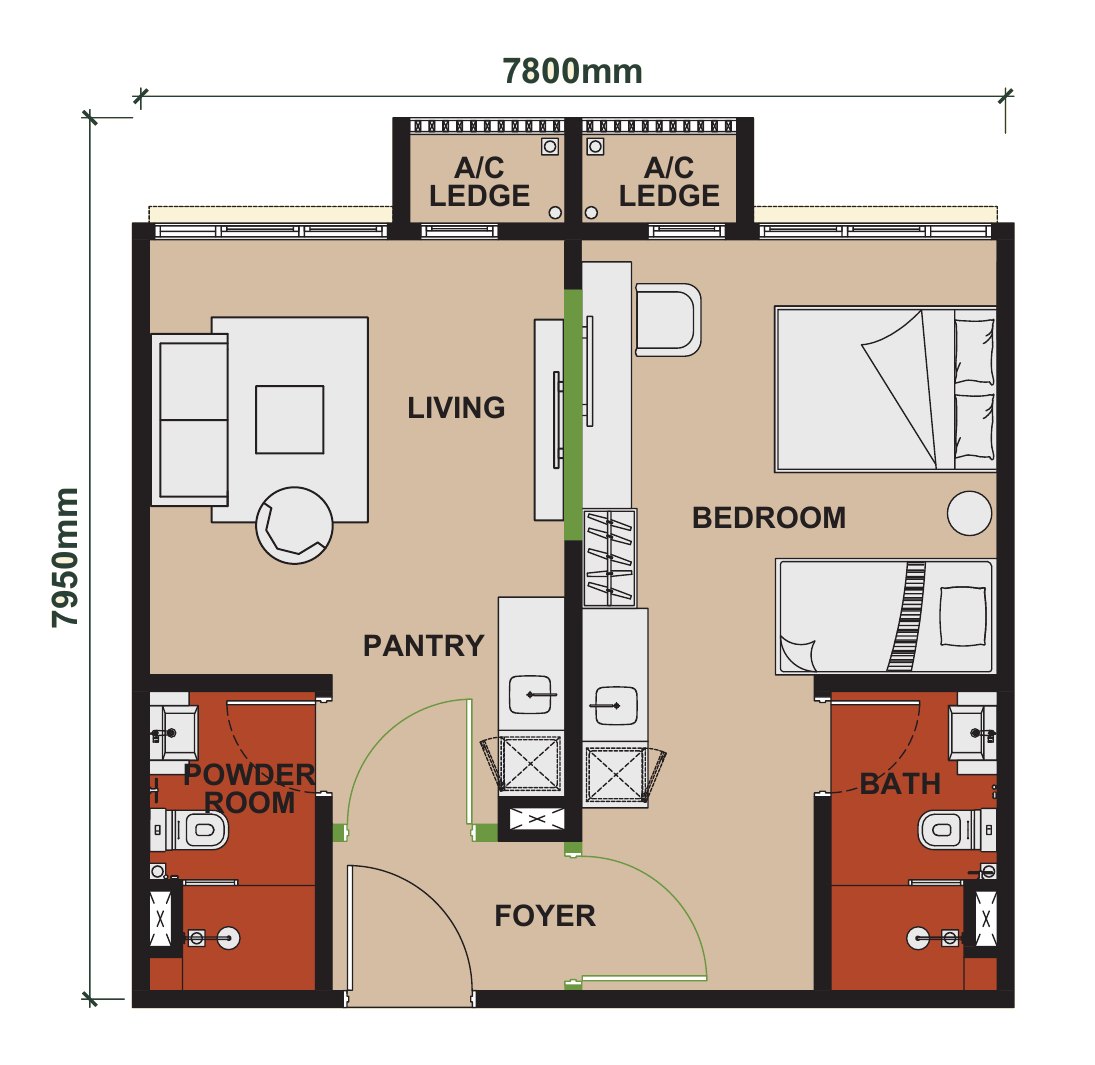
It suits investors who want two rental incomes from one loan, or owners who want to live in one suite and rent the other. Check the project's rules on short-term rentals before you buy.
Can foreigners buy property in Penang?
Yes, with Penang State Authority consent and above the state's minimum price. Non-citizens also pay a flat 8% stamp duty on transfers from 1 January 2026. Banks usually lend foreigners 60% to 85% of the price.
| Area | Strata (condo) | Landed |
|---|---|---|
| Penang Island | RM1,000,000 | RM3,000,000 |
| Penang Mainland (Seberang Perai) | RM500,000 | RM1,000,000 |
Commonly quoted minimum prices as at November 2026. A state levy and consent fee may apply, and Malay reserved land and some quota units cannot be sold to foreigners. MM2H holders: see the MM2H section below. For areas and projects, see our Foreign Buyer’s Guide to Penang.
Law: National Land Code 1965, section 433B (state consent). Official source: Penang State Government. Always confirm the current figures before booking.
MM2H: buying in Penang with a Malaysia My Second Home visa
MM2H is Malaysia’s long-stay visa for foreigners. Since 2024 it has three tiers (Silver, Gold and Platinum), each needing a fixed deposit and the purchase of a Malaysian property.
| Tier | Fixed deposit | Minimum property purchase | Visa period |
|---|---|---|---|
| Silver | USD 150,000 | RM600,000 | 5 years |
| Gold | USD 500,000 | RM1,000,000 | 15 years |
| Platinum | USD 1,000,000 | RM2,000,000 | 20 years |
- In Penang, the property must meet the higher of your MM2H tier minimum and Penang’s foreign buyer minimum (see the table above).
- Foreign buyer rules still apply: state consent, a flat 8% stamp duty, and a loan of usually 60% to 85%.
- The minimum age is 25. You apply through a licensed MM2H agent, and the programme is run by the Ministry of Tourism, Arts and Culture (MOTAC).
Programme rules and Penang’s figures change from time to time, so confirm the current requirements with MOTAC or a licensed MM2H agent before you book. We can recommend projects that meet your tier.
Official source: MM2H (Ministry of Tourism, Arts and Culture). As at 15 Nov 2026.
Steps to buy a new launch: from booking to keys
Book the unit, verify yourself on iDsaya, sign the SPA digitally (eSPA) and the loan agreement, pay by progress billing during construction, then collect your keys at vacant possession. Defects are covered for 24 months after that.
- Choose and book. Pay the booking fee and get an official receipt. It is usually part of your 10% down payment.
- Apply for the loan. Submit to 2–3 banks early, since approval takes about 1–3 weeks.
- Verify yourself on iDsaya. Since 1 January 2026, the SPA for a residential unit under construction is signed digitally, so you first need a verified digital ID on the iDsaya app (by Pos Digicert). Do this as soon as you book, because approval takes about 3 working days.
- Install iDsaya on the phone you will sign with. One account works on one device only.
- Enter your mobile number, accept the terms and key in the 6-digit code sent by SMS.
- Choose your ID type: MyKad for Malaysians (scan front and back) or passport for foreigners.
- Check your details, then do the live face scan when asked.
- Set a 6-digit PIN. You will use it to log in and to sign. Fingerprint or Face ID login is optional.
- Wait for approval (about 3 working days). The app shows when your digital ID is ready.
I don’t have a Malaysian phone number, but I am Malaysian
iDsaya’s app sign-up needs a supported phone number. Without a Malaysian (+60) number, apply manually instead:
- Tell your developer or us first. The developer can submit the application for you.
- Fill in the iDsaya individual application form (your developer or Pos Digicert will send it to you).
- Email the form with a copy of your MyKad (front and back) to Pos Digicert at customercare@posdigicert.com.my.
- The iDsaya team checks your details and verifies your identity manually, then confirms by email.
- Once your digital ID is approved, continue with step 4 to sign your eSPA.
Pos Digicert customer care: +603 8800 8008, Monday to Friday, 9am to 5pm.
- Sign the SPA (eSPA). You receive an email from KPKT’s HIMS system when your SPA is ready. Review and agree to it, create your digital certificate PIN from the next email, then sign with that PIN and the one-time code shown in iDsaya. Pay the balance of your 10% down payment. The developer then stamps the eSPA, and it has the same legal effect as a printed SPA.
- Sign the loan agreement. The bank pays the developer stage by stage as construction progresses. You pay interest only on the amount released.
- Vacant possession (VP). Your SPA states when the developer must hand over the keys. Check the timeline for your project, since developers sometimes apply for an extension of time. If the developer is late beyond the agreed date, you can claim late delivery compensation under the SPA.
- Pay the VP charges and collect your keys. Before handover you usually pay advance maintenance and sinking fund (often a few months in advance), water and electricity deposits, and access card deposits. The amounts differ by project and are listed in your VP letter.
- Defect liability period (DLP). Report defects within 24 months from VP; the developer must repair them at its own cost.
- Strata title and management. Pay maintenance and sinking fund (sinking fund is 10% of the maintenance charge) to the management body.
Law: Housing Development (Control and Licensing) Act 1966 and its Regulations; Digital Signature Act 1997 (eSPA signing); Strata Titles Act 1985; Strata Management Act 2013. Official sources: KPKT (Ministry of Housing and Local Government), Pos Digicert eSPA.
RPGT 2026: tax when you sell
Real Property Gains Tax applies to the profit when you sell. Malaysians pay 0% after holding the property for more than 5 years.
| Sold in | Citizens & PR | Foreigners |
|---|---|---|
| Years 1–3 | 30% | 30% |
| Year 4 | 20% | 30% |
| Year 5 | 15% | 30% |
| Year 6 onwards | 0% | 10% |
Citizens get a one-time exemption on one residential property and an exemption of RM10,000 or 10% of the gain, whichever is higher. The holding period for a new launch generally counts from the SPA date.
Law: Real Property Gains Tax Act 1976 (Schedule 5). Official source: LHDN. Rates as at 15 Nov 2026 (unchanged in Budget 2026).
Frequently asked questions
How much stamp duty do I pay when buying a property in Malaysia?
For Malaysian citizens: 1% on the first RM100,000, 2% on the next RM400,000, 3% on the next RM500,000 and 4% above RM1 million, plus 0.5% of the loan for the loan agreement. Non-citizens pay a flat 8% on transfers from 1 January 2026.
What is iDsaya and do I need it to buy a property?
iDsaya is the digital ID app by Pos Digicert. From 1 January 2026, the sale and purchase agreement for a residential unit under construction is signed digitally (eSPA) through KPKT’s HIMS system, so buyers verify their identity on iDsaya first. Approval takes about 3 working days.
Is there a stamp duty exemption for first-time home buyers?
Yes. Citizens buying their first home up to RM500,000 get a 100% exemption on the transfer and the loan agreement, for SPAs signed up to 31 December 2027.
What is the maximum home loan margin in Malaysia?
Usually up to 90% for the first and second home. From the third outstanding housing loan, the cap is 70%. Foreign buyers usually get 60% to 85%.
MRTA or MLTA: which is better?
MRTA for the lowest cost if you plan to keep the loan; MLTA if you want level cover that can move with you when you refinance or sell.
Can foreigners buy property in Penang?
Yes, with state consent and above the minimum price: commonly RM1 million strata and RM3 million landed on the island, RM500,000 strata and RM1 million landed on the mainland. Stamp duty is a flat 8%.
How much RPGT do I pay when I sell?
Citizens: 30% in years 1–3, 20% in year 4, 15% in year 5, 0% from year 6. Foreigners: 30% up to year 5, 10% from year 6.
Can I buy property in Penang under MM2H?
Yes. MM2H now has Silver, Gold and Platinum tiers, with fixed deposits of USD 150,000, 500,000 and 1 million, and a required property purchase of at least RM600,000, RM1 million or RM2 million. In Penang the property must also meet the state’s foreign buyer minimum, whichever is higher.
What is the defect liability period for a new property?
24 months from vacant possession. Report defects in writing; the developer repairs them at its own cost.
Do I pay legal fees for a new launch?
Often not for the SPA: many developers include free SPA legal fees, and some also cover the loan legal fees. Check the sales package for each project.
Can I rent out my Penang condo for short stays?
Only with a TIP licence from the city council, required since 1 August 2026. On Penang Island ordinary condos and apartments are not allowed; commercial-title serviced apartments, SoHo units and landed houses may be considered, and the building must approve with at least 75% of the votes. On the mainland more building types may be allowed.
Will cash-out refinancing affect my loan eligibility in 2027?
Yes, if the cash-out is for personal use. From 1 January 2027, Bank Negara treats the amount above your outstanding home loan as personal financing and banks must assess it over 10 years, so the monthly commitment counted in your DSR is much higher. Cash-outs for renovation, MRTA, legal fees, education or business are exempt with proof.
Last updated 15 Nov 2026. This guide is general information only and is not legal, tax or financial advice. Please confirm figures with your lawyer, bank or the official sources linked.
Ready to look?
Find a project that fits your budget.
Compare new launches in Penang by price, area, bedrooms and tenure, or tell us your budget and we’ll do the sums with you, including loan eligibility.
Browse all projectsChat with us